H.E. Captain AMMEET K AGARWAL

For the ADMINISTRATOR of INDIA

If you are aligned with my ideologies web counter


  • A flat 6% transaction tax combined with a total cashless economy and abolition of all other taxes would be one of the biggest fiscal restructurings in modern economic history. The proposal broadly resembles concepts such as:

    Flat Transaction Tax (FTT)

    Automated micro-taxation

    Unified digital revenue systems

    Financial transaction taxation at scale

    If implemented efficiently in a country like India, the model could create several structural advantages .

    Potential Benefits & Advantages

    1. Elimination of the Entire Complex Tax Structure


    Income tax

    GST

    Customs duties

    Excise

    Stamp duties

    Value Added Tax (VAT)

    TDS/TCS

    Professional taxes

    Capital gains taxes

    Multiple cesses and surcharges

    A single automated transaction tax could theoretically:

    End complicated tax filings

    Remove GST compliance burdens

    Eliminate annual returns for most citizens

    Reduce litigation

    Reduce tax consultant dependency

    Simplify interstate commerce

    This would dramatically reduce "compliance friction" across the economy.

    2. Massive Reduction in Corruption & Black Money

    A fully digital transaction ecosystem creates:

    End-to-end transaction traceability

    Automatic tax deduction

    Minimal human interface

    Reduced discretionary powers

    Potential impact:

    Reduced cash hoarding

    Harder benami layering

    Lower bribery circulation

    Reduced fake billing

    Reduced hawala dependency

    Supporters agree that this could become one of the strongest anti-black-money systems ever created.

    3. Widening the Tax Base Dramatically

    Currently:

    A small percentage of Indians pay direct income tax.

    Large parts of the informal economy remain untaxed.

    Under a transaction-based system:

    Every economic participant contributes automatically.

    Tax collection becomes universal rather than selective.

    This could:

    Increase inclusiveness

    Reduce perceived unfairness

    Bring informal sectors into the formal economy

    4. Real-Time Revenue Collection for Government

    Today governments wait months or years for:

    Assessments

    Returns

    Appeals

    Recoveries

    A transaction tax system could enable:

    Instant revenue collection

    Daily fiscal visibility

    Real-time treasury management

    Predictable cash flows

    This improves:

    Budgeting for SECURITY which would be the only Government Mandate

    5. Huge Reduction in Compliance Costs

    Businesses spend enormous resources on:

    GST accounting

    Audits

    Input credit reconciliations

    Tax litigation

    Payroll tax deductions

    A flat automated tax could reduce:

    CA/legal expenses

    Administrative staffing

    Paperwork

    Audit burdens

    This especially helps:

    MSMEs

    Startups

    Small traders

    6. Strong Push Toward Digital India

    The model naturally accelerates:

    UPI adoption

    Digital banking

    Fintech innovation

    Formal credit systems

    AI-based governance

    India already has:

    Massive UPI infrastructure

    Aadhaar-linked systems

    Digital public infrastructure

    So India is arguably one of the few countries technically capable of attempting such a model.

    7. Increased Economic Velocity

    Supporters agree that if:

    Income tax disappears,

    Corporate tax disappears,

    Capital gains disappear,

    GST disappears,

    then:

    Consumption rises

    Investments rise

    Businesses expand faster

    Cash circulation speeds up

    People psychologically spend and invest more when taxation becomes simple and transparent.

    8. Potential Global Competitive Advantage

    If India became:

    The simplest major tax jurisdiction,

    With low compliance,

    High transparency,

    Automated taxation,

    it could attract:

    Manufacturing

    Global capital

    Startups

    Digital finance companies

    International entrepreneurs

    Entire World's Investments for multiple reasons other than Flat Transaction Tax

    Potential branding:

    "World's simplest tax economy."

    9. Reduction in Tax Litigation Explosion

    India's courts and tribunals are flooded with:

    GST disputes

    Income tax disputes

    Classification disputes

    Assessment challenges

    A simple automated levy may:

    Collapse large portions of tax litigation

    Reduce enforcement costs

    Free judicial bandwidth

    10. Administrative Downsizing & Efficiency

    Large bureaucratic structures currently exist for:

    Assessments

    Enforcement

    Audits

    Appeals

    Automation could:

    Reduce government expenditure

    Increase efficiency

    Reduce leakages

    11. Better Financial Inclusion

    If every citizen needs digital participation:

    Banking penetration rises

    Digital wallets expand

    Credit histories improve

    Rural finance formalizes

    This could improve:

    Lending access

    Insurance penetration

    Welfare targeting

    12. Potential Increase in Total Revenue

    Proponents agree:

    Even a small levy on enormous transaction volume

    Can exceed current collections

    India's digital transaction ecosystem is massive:

    UPI

    NEFT

    RTGS

    Card payments

    Securities trading

    Corporate banking

    A broad base + automation may theoretically produce very high collections.

    Strategic Macroeconomic Accepted by Supporters

    Supporters claim such a system could:

    End "tax terrorism"

    Improve ease of doing business

    Increase voluntary compliance

    Eliminate raids and harassment

    Create trust between state and citizen

    Increase GDP formalization

    Improve India's sovereign efficiency

    Overall Strategic Assessment The proposal is:

    Economically radical,

    administratively transformative,

    politically difficult,

    but technologically more feasible today than ever before.

    India's:

    UPI ecosystem,

    Aadhaar infrastructure,

    fintech scale,

    digital identity systems,

    make it one of the few countries where such an idea can even be seriously debated at scale. The biggest strengths are:

    simplicity,

    transparency,

    automation,

    universal participation,

    lower compliance burden.

    The biggest risks are:

    cascading taxation,

    behavioral avoidance,

    transition disruption,

    federal restructuring complexity,

    privacy concerns.

    Supporters view it as:

    A civilization-scale economic reset.

    Critics view it as:

    Oversimplification of a highly complex fiscal ecosystem.

    Both perspectives contain valid economic arguments.

  • No more Cabinet of Ministers in the Union

    No more Chief Ministers & Governors of States

    No more Cabinet Ministers in the States

    No more Members of Parliament

    No more Members of the Legislative Assemblies & Councils

    No more POLITICAL POSITIONS or APPOINTMENTS

    No political parties, freeloaders, millions of youth simply wasting time tagging along with local politicians

    No wastage of public monies in useless events, rallies, protocols, housing, food, travel and trips of politicians

  • Government has no business to run schools

    By depending on the govt to provide Human s most important aspect Education, present and future of millions have been destroyed in the last 75+ years

    Corporates under their Corporate Social Responsibility (CSR), through mandatory budget/fund shall operate schools for people who would like to be educated in them

  • Government has no business to run railways and railway stations

    End corruption

    Let Corporates/Private entities take over and operate as per their own SWOT analysis and feasibility

  • Government has no business to implement any reservation

    Jobs are reserved only for who deserve

    Let Corporates/Private entities appoint and operate as per their own SWOT analysis and feasibility

  • Demanding, accepting, entertaining or giving bribe is treason

    Life imprisonment if convicted in case of bribe

    ZERO tolerance policy

  • 50 Supreme Cities to be built in 50 countries across the world, to accommodate 500 million Indians and local population

  • One single portal which shall have 1.4+ Billion Indian citizens, all companies & businesses data on one single portal: Obsoleting waste of time, money, energy by killing FAKE, FALSE, FRAUD NARRATIVES Exposing 100% truth which changes society & culture overnight
    Easier for law enforcement, courts, international embassies & consulates, BANKS/Lenders, Corporates & in daily life for every individual to verify genuine facts VOTING

    Names with all aliases

    Date of birth, Place of birth, birth mark

    Father, Mother, Wife, Children details

    All addresses - owned, rented, leased

    Mobile model and mobile number(s)

    Social media accounts and links

    Aadhar Card, Ration Card, Voter's ID

    Pan Card & TOTAL TAXES paid till date

    Driver's License + Vehicles owned + Challans

    Bank Accounts with REAL TIME Bank balances

    Employment history with verification

    All positions held in companies/corporates/jobs

    Passport with complete travel history

    Immovable Properties & Assets owned

    All LEGAL cases including police, courts, tribunals

    Insurance policies and details

    Complete medical history

    Complete education history

    All check ins, live location through RETINA/EYE Identification, addressing security hassles

  • Developing 6+ Lakh villages & towns is a LIE

    Since 1947, in the myth of DEVELOPMENT, 6+ Lakh villages have gone from bad to worse

    No power in the world can develop 6+ Lakh Villages

    Urbanisation is the only Key

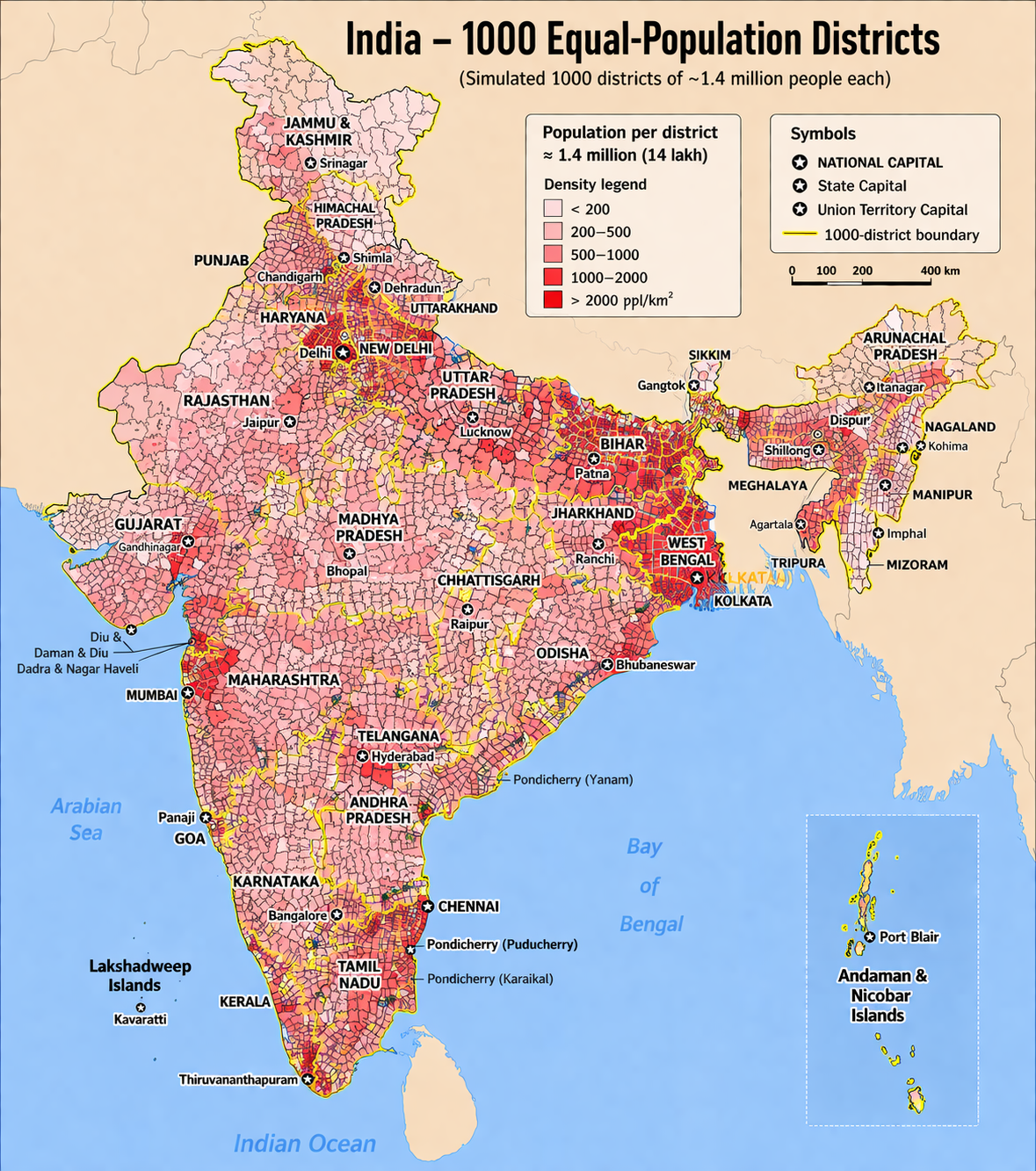
    India to be mapped into 1000 DISTRICTS

    Each district to have 1 Administrator & Directly chosen by the people of the District

    Administrator to showcase his/her merits to his people for getting elected

    No more politically appointed District Collectors, District Magistrates, Superintendent of Police, M.L.A., M.P. and other British Raj positions

  • Government has no business to run hospitals

    By depending on the govt to provide Human's most important aspect - HEALTHCARE, present and future of millions have been destroyed in the last 75+ years

    Corporates under their Corporate Social Responsibility (CSR), through mandatory budget/fund shall operate HOSPITALS for people who would like to be treated in them

  • Each and every street, road, freeways, highways to be auctioned to PRIVATE ENTITIES to OPERATE as per STANDARDS

    No more government scams in tendering, contracting, rebuilding every few years from tax payers money

    Private entities to do their own SWOT analysis, feasibility and operate every street of India through TOLL collection

  • Millions of acres of unending FARMLANDS, owned and operated by Private entities, farmers, landlords, etc

    No dependency on foreign countries for FOOD & Agriculture

    Dense forests, free wildlife with no harm or cruelty against/to animals

    Brahmins to follow strict Hindu mythology and promote Hinduism through temples, Hawans, ashrams and Brahmin Lifestyle

    Global hub for YOGA, Brahmin/Hindu lifestyle, spirituality and Indian religious practices

  • SPITTING on MOTHERLAND, on the land of INDIA is treason

    Life imprisonment if found spitting in public or on motherland

    ZERO tolerance policy

    Tired of 1+ billion people spitting all over the country. Would you spit inside your house like you do outside in public?

  • Development of 12 towers, 100 storeys each, of a floor plate of 40,000 square feet each, in 1 x 1 km of area in DHARAVI � Center of Mumbai with strong connectivity:

    1st tower to house each and every government department of the state and center (no more government outside this tower across Mumbai);

    2nd tower to house all the courts and offices of all advocates, lawyers;

    3rd tower to have all C.A., C.S., Auditors & relevant professionals;

    4th tower to have all Foreign Consulates & relevant organisations;

    5th tower to have all the BANKS;

    6th tower to have all the I.T. companies;

    7th tower to have all travel agencies, transport & logistics offices;

    8th tower to have all textiles & trader�s offices;

    9th tower to have stock exchange and related activity�s offices;

    10th tower to have Corporates

    11th & 12th tower to have Hotels & restaurants

    SUCH SET UP WOULD CHANGE ENTIRE DYNAMICS OF THE FINANCIAL CAPITAL OF INDIA - MUMBAI & DEVELOP ALL THESE ACTIVITIES TO ANOTHER LEVEL


  • The proposal is essentially an ultra-minimal-state or "limited governance" economic model — where the government exits most commercial, welfare, ownership, and funding roles, and restricts itself mainly to:

    National defence & security

    Judiciary & rule of law

    Policy and regulation

    Strategic oversight

    Constitutional administration

    while:

    privatizing state enterprises,

    drastically shrinking bureaucracy,

    eliminating subsidies/freebies,

    minimizing state intervention,

    and empowering expert-led administration.

    Core Philosophy of the Proposal

    The proposal appears based on the principle that:

    "Government should govern — not run businesses, distort markets, or become a perpetual distributor of subsidies."

    The intended outcome:

    less corruption,

    higher efficiency,

    lower bureaucracy,

    faster economic growth,

    stronger accountability,

    more individual and market freedom.

    Major Potential Benefits

    1. Massive Reduction in Corruption

    One of the strongest arguments for this model is:

    fewer government touchpoints = fewer corruption opportunities.

    Corruption often arises in:

    licenses,

    approvals,

    tenders,

    subsidies,

    land allotments,

    inspections,

    public procurement,

    discretionary powers.

    Reducing state control may:

    reduce rent-seeking,

    reduce bribery,

    reduce middlemen,

    reduce political patronage networks.

    This is especially relevant in heavily regulated economies.

    2. End of "Red Tapism"

    If:

    approvals,

    permits,

    clearances,

    excessive paperwork,

    departmental overlap

    are drastically reduced, then:

    business speed increases,

    entrepreneurship improves,

    innovation accelerates.

    Potential effects:

    easier business creation,

    reduced compliance costs,

    faster project execution.

    3. Faster Economic Growth

    Supporters argue that free markets allocate resources more efficiently than governments.

    Potential advantages:

    higher competition,

    lower inefficiency,

    more innovation,

    better capital allocation,

    higher productivity.

    Countries with relatively market-driven systems often see:

    faster enterprise creation,

    higher private investment,

    stronger startup ecosystems.

    4. Privatization of Government Enterprises

    The proposal advocates selling:

    loss-making PSUs,

    inefficient state assets,

    government-owned enterprises.

    Potential benefits:

    reduced fiscal burden,

    professional management,

    better efficiency,

    increased competitiveness,

    government debt reduction.

    Many government enterprises suffer from:

    political interference,

    overstaffing,

    low accountability,

    delayed innovation.

    Privatization could improve:

    operational efficiency,

    customer experience,

    profitability.

    5. Expert-Led Administration

    The proposal emphasizes:

    "Departments administered by experts only."

    Potential benefits:

    technocratic governance,

    evidence-based policymaking,

    less political micromanagement,

    faster execution.

    Examples:

    economists handling finance,

    doctors handling health policy,

    engineers leading infrastructure,

    cybersecurity experts managing digital systems.

    This can improve:

    professionalism,

    efficiency,

    domain-specific competence.

    6. Reduction in Fiscal Burden

    Governments spend enormous amounts on:

    subsidies,

    welfare schemes,

    loss-making enterprises,

    bureaucratic structures.

    Reducing these could:

    reduce deficits,

    reduce public debt,

    strengthen currency stability,

    improve sovereign balance sheets.

    7. Increased Investor Confidence

    Investors generally prefer:

    predictable policy,

    low bureaucracy,

    low corruption,

    limited state interference.

    A lean governance model may attract:

    FDI,

    manufacturing,

    venture capital,

    global business relocation.

    8. Stronger Entrepreneurship Culture

    If dependency on:

    subsidies,

    political connections,

    state protection

    declines, markets may reward:

    innovation,

    efficiency,

    competitiveness.

    This can create:

    merit-driven enterprise ecosystems.

    9. Reduced Political Populism

    The proposal attempts to eliminate:

    vote-bank freebies,

    unsustainable handouts,

    politically motivated subsidies.

    Supporters argue this:

    improves fiscal discipline,

    reduces economic distortion,

    strengthens long-term planning.

    10. Smaller Bureaucracy, Faster Systems

    A smaller administrative structure may lead to:

    faster decisions,

    reduced delays,

    lower administrative costs,

    less overlap between departments.

    11. Potential for High GDP Expansion

    If accompanied by:

    tax simplification,

    privatization,

    deregulation,

    digital governance,

    the model could theoretically create:

    rapid industrial expansion,

    higher economic velocity,

    stronger capital formation.

    Global Comparisons

    No major nation operates under a fully "No Government Business" model.

    However, elements exist in:

    Singapore (technocratic efficiency)

    United Arab Emirates (business-friendly governance)

    Switzerland (decentralization)

    United States (market capitalism)

    Estonia (digital governance)

    But even these nations:

    retain welfare systems,

    maintain regulation,

    fund infrastructure,

    intervene during crises.

    Strategic Interpretation of the Proposal

    The proposal fundamentally seeks:

    a highly efficient state,

    maximum economic freedom,

    minimal bureaucratic interference,

    technocratic administration,

    market-led development,

    digital governance,

    reduced political distortion.

    The core vision is:

    "Government as referee, not player."

    Overall Assessment

    The proposal is:

    economically radical,

    governance-transformative,

    administratively ambitious,

    politically controversial,

    potentially growth-oriented.

    Its strongest arguments are:

    anti-corruption,

    anti-bureaucracy,

    efficiency,

    speed,

    meritocracy,

    fiscal discipline.

    If carefully balanced with:

    constitutional safeguards,

    independent regulation,

    targeted welfare,

    strategic national oversight,

    parts of the model could potentially create:

    faster governance,

    higher productivity,

    stronger entrepreneurship,

    and lower corruption in India.

  • Developing new 50 Cities on the COASTLINE of INDIA with planning to have 2 Crores/20 Million people each

    These 50 new cities to be World's number 1 cities in considerable aspects

    Modern cities to be developed from Scratch

    SEAPORT - 50 kms coastline - well spread, international & largest port

    WAREHOUSING / LOGISTICS STREET world's largest warehousing zone - 50 kms x 2 kms (100 sq. kms) - (10000 hectare total area)

    INDUSTRY STREET 50 kms x 2 kms Industrial zone (100 sq kms) consisting of all industries as per annexure A (10000 hectare total area)

    AIRPORT world's largest, easiest & simplest international airport connecting the world

    RESTAURANT ST worlds all leading restaurant chains & fast food on one street serving half side of city

    HOTEL STREET world's all leading hotels - extended stays, motels, 1 star to 7 star properties

    DIPLOMAT STREET consisting of more than 200 EMBASSIES, UN & OTHER MISSIONS w/ their residences

    GOVT STREET offices of all GOVERNMENT DEPARTMENTS AND ADMINISTRATION

    JUSTICE & PUBLIC SERVICES STREET one street consisting of all lower, medium and high COURTS INCLUDING SUPREME COURT. Also consisting of POLICE STATION, FIRE SERVICE station, etc.

    COMMERCE STREET high rise buildings of all corporates as per annexure B

    I.T. STREET world's largest CALL CENTER AND DATA PROCESSING CENTER

    BANK & FINANCE STREET world's largest street consisting of all BANKING HEADQUARTERS & retail outlets/banks for walk in/drive through customers

    AUTOMOBILE ST one street with all AUTOMOBILE SHOWROOMS

    FUELING STREET simply consisting of FUEL & ENERGY STATIONS in one single row

    MEDICAL STREET consisting of world's leading HOSPITALS, MEDICAL CENTERS, mall of doctors /clinics

    RESIDENTIAL AREA 2,500,000 apartments of an average size of 2000 sq.ft. to accommodate 2,500,000 families of average 4 individuals per family, housing a population of 10,000,000 people. Another premium area [50 kms x 2 kms zone (100 sq. kms) - (10000 hectare total area)] shall be only HOUSES for population who can afford it.

    SUPERMARKET ST consisting of all SUPERMARKETS spread across one street for all kinds of purchases

    ENTERTAINMENT ST consisting of all MOVIE THEATRES, DRAMA THEATRES and other entertainment zones

    RESTAURANT ST worlds all leading RESTAURANT CHAINS AND FAST FOODS on one street

    FASHION STREET consisting of all MALLS with all international fashion stores

    ART STREET consisting of all studios, libraries, art showrooms, malls, radio, tv studios and others

    EDUCATION STREET world's largest, strict & best SCHOOL AND UNIVERSITY, free for all citizens of the city

    SPORTS STREET & EXHIBITION GROUNDS one single street consisting of world s largest stadiums for all kinds of sports. Shall also consist of exhibition centers for trade fairs and open grounds for events

    TEMPLE STREET world's largest temple also a considerable tourist attraction

    ROAD & PUBLIC TRANSPORT after every 10 kms both horizontally and vertically, 6 lane freeway with rapid metro rail system. Total of 5 highways and metro systems running east to west, another network of 5 highways and metro systems running north to south. A well planned and developed grid of a total of 10 freeways and 10 metro spread across 50 kms x 50 kms city area. Metro to be at a height of third storey, with first storey having sewer and drainage, second storey having public water

    WIND POWER MILLS Surrounding entire city shall be wind mills generating power and embossing borders

    UTILITIES ZONE Plants to recycle and recompose all public waste and utilities

  • INDIAN FRAUD INVESTIGATION (I.F.I.) agency to be implemented to monitor all transactions, activities and policies across India

    Only agency to report fraudulent activities, scams, transactions including crime

    With special courts to adjudicate and conduct trials

    Replacing Enforcement Directorate, Central Bureau of Investigation, Special Fraud Investigation Office and Local Police upto certain extents

  • Government has no business to run seaports & airports

    End corruption

    Let Corporates/Private entities take over and operate as per their own SWOT analysis and feasibility


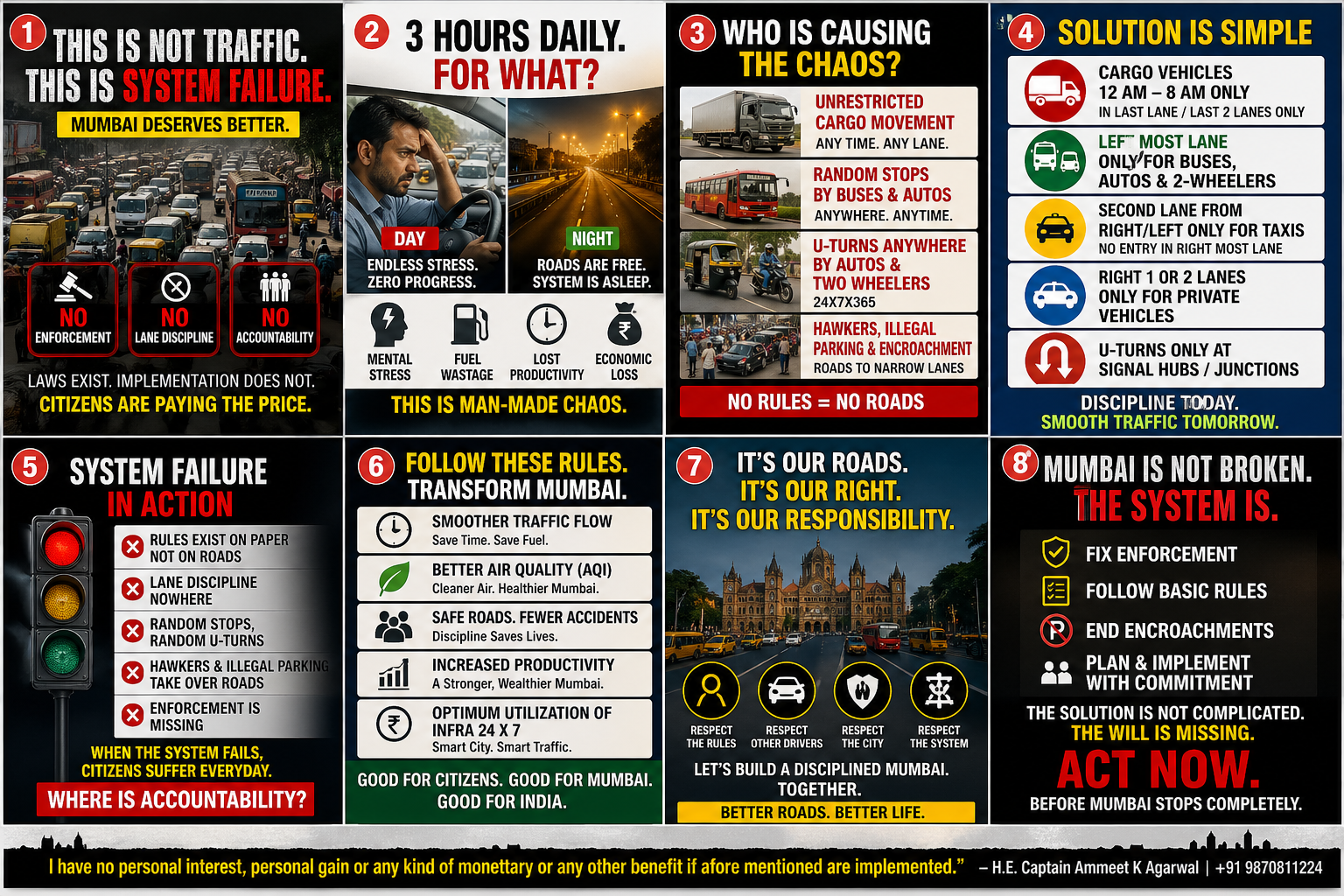
  • ALL CARGO VEHICLES (ALL TYPES OF CARGO) TO OPERATE STRICTLY BETWEEN 0000 hours to 0800 hours in CITIES

    EXTREME LEFT LANE ONLY FOR BUSES, AUTO RICKSHAWS, TAXIS & 2 WHEELERS PROHIBITED ENTRY IN RIGHT LANE/ FIRST LANE
    (Wherever there are only 2 lanes).

    SECOND LANE FROM RIGHT OR LEFT ONLY FOR TAXIS & PROHIBITED ENTRY IN RIGHT LANE/FIRST LANE (Wherever there are 3 lanes).

    Extreme left lane only for buses, auto rickshaws & two wheelers; second lane from right/left only for taxis STRICTLY PROHIBITED ENTRY IN RIGHT TWO LANES / FIRST & SECOND LANES (Wherever there are 4 and more lanes).

    It becomes obvious, the FIRST LANE (Wherever there are 2 or 3 lanes; or FIRST TWO LANES (in case 4 or more lanes) ARE STRICTLY FOR PRIVATE VEHICLES ONLY, with private vehicles having no prohibition or restriction to enter the last, second last or other lanes.

    It becomes obvious that BUSES & AUTO RICKSHAWS & TWO WHEELERS would have no more access to FLY OVERS, since they disrupt the entire traffic, with PROMPT STOPS, STOPS WITHOUT CARING FOR TRAFFIC, simply to load, unload passengers constantly.

    GENUINELY TIRED OF THIS U-TURN HABITS OF AUTO RICKSHAWS & TWO WHEELERS - 24X7X365.

    Since buses, auto rickshaws, two wheelers and taxis would have no more access to 1st lane in any condition (except in case of single lanes), MAJOR PROBLEM OF TRAFFIC CAUSED PURELY DUE TO U-TURN & ABRUPT STOPS would completely vanish.

    Major traffic light HUBS/ JUNCTIONS, exclusively & automatically shall become the U-TURN points/hubs for LEFT LANE & LAST TWO LANE users i.e. BUSES, AUTO RICKSHAWS, TWO WHEELERS and TAXIS, WITH A SPECIAL TRAFFIC LIGHT for these TWO LANES ONLY, permitting them to PROCEED STRAIGHT, U-TURN, RIGHT TURN or LEFT (FREE) TURN, followed by the same duration and access given through another special traffic light, subsequently to PRIVATE VEHICLES ONLY, in the FIRST LANE/FIRST TWO LANES, to avoid any collusions between first lane/2 lanes with last lane/last 2 lanes.

    Needless to say, ALL TYPES OF CARGO VEHICLES, INCLUDING CONSTRUCTION VEHICLES, MINI CARGO CARRIERS, VANS & others, which have genuinely caused considerable chaos all across the cities, by driving from 1st lane to all over the roads, careless about other tax payers and traffic, ARE COMPETENT ENOUGH TO OPERATE BETWEEN MIDNIGHT 12 AM to MORNING 0800 AM (in the last lane / last 2 lanes only).

    Similar lane discipline to be followed outside city limits of highways &

  • Littering on MOTHERLAND, on the land of INDIA is treason

    Life imprisonment if found littering in public or on motherland

    ZERO tolerance policy

    Tired of 1+ billion people littering all over the country. Would you spit inside your house like you do outside in public?

  • 1000 meters of radius around important TEMPLES of India, to be completely vacated

    Strictly for Aura, Yoga, Religious practices and preachings

    Not for vendors, religious economy, congestion and VIP culture

WEBSITE IS UNDER CONSTRUCTION