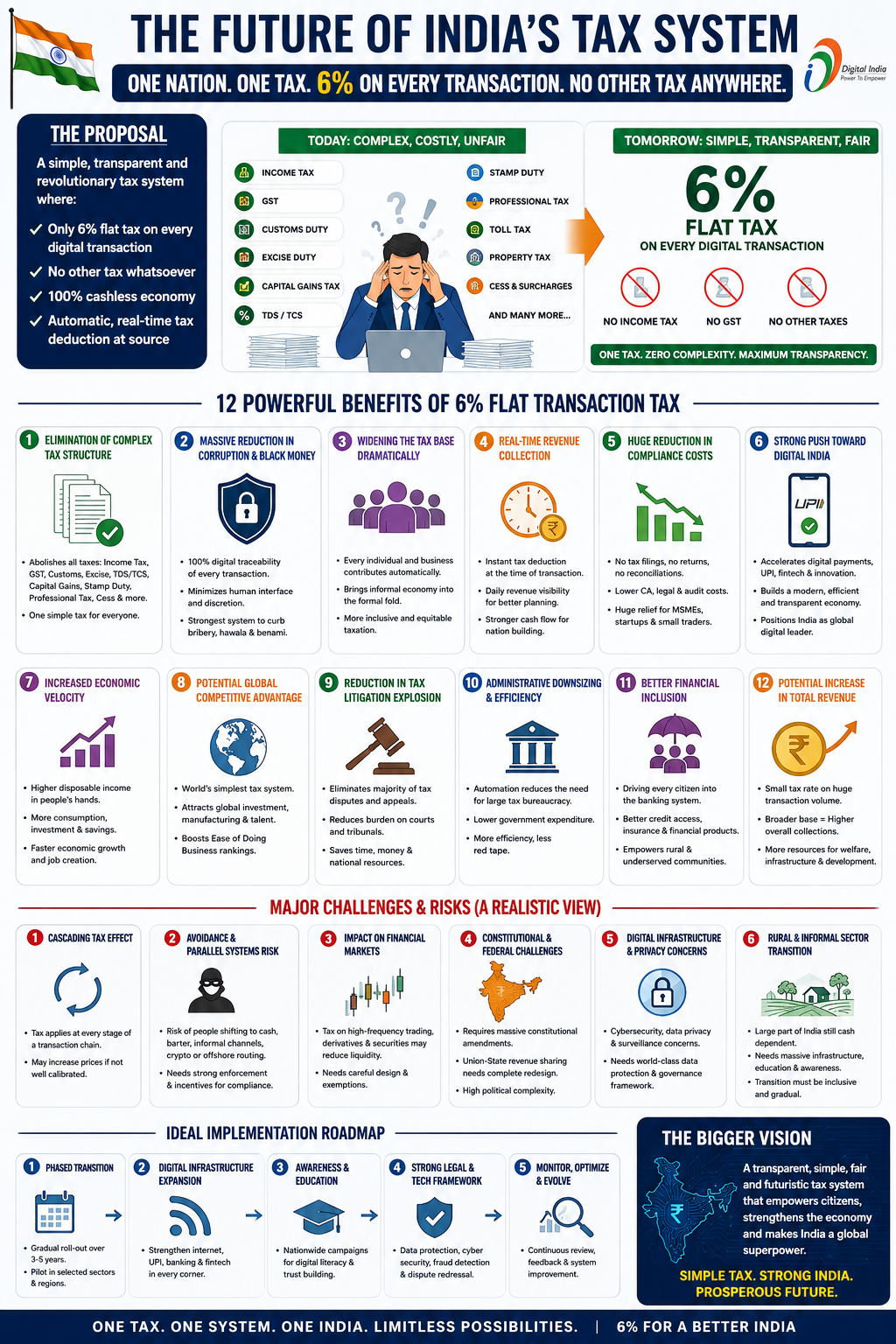
A flat 6% transaction tax combined with a total cashless economy and abolition of all other taxes would be one of the biggest fiscal restructurings in modern economic history.
The proposal broadly resembles concepts such as:
Flat Transaction Tax (FTT) | Automated micro-taxation | Unified digital revenue systems | Financial transaction taxation at scale
If implemented efficiently in a country like India, the model could create several structural advantages .
Potential Benefits & Advantages
1. Elimination of the Entire Complex Tax Structure
Income tax | GST | Customs duties | Excise | Stamp duties | Value Added Tax (VAT) | TDS/TCS | Professional taxes | Capital gains taxes | Multiple cesses and surchargesA single automated transaction tax could theoretically:
End complicated tax filings | Remove GST compliance burdens | Eliminate annual returns for most citizens | Reduce litigation | Reduce tax consultant dependency | Simplify interstate commerce | This would dramatically reduce "compliance friction" across the economy
2. Massive Reduction in Corruption & Black Money
A fully digital transaction ecosystem creates:End-to-end transaction traceability | Automatic tax deduction | Minimal human interface | Reduced discretionary powers |
Potential impact:
Reduced cash hoarding | Harder benami layering | Lower bribery circulation | Reduced fake billing | Reduced hawala dependency
Supporters agree that this could become one of the strongest anti-black-money systems ever created
3. Widening the Tax Base Dramatically
Currently:A small percentage of Indians pay direct income tax | Large parts of the informal economy remain untaxed |
Under a transaction-based system:
Every economic participant contributes automatically | Tax collection becomes universal rather than selective.
This could:
Increase inclusiveness | Reduce perceived unfairness | Bring informal sectors into the formal economy
4. Real-Time Revenue Collection for Government
Today governments wait months or years for:Assessments | Returns | Appeals | Recoveries
A transaction tax system could enable:
Instant revenue collection | Daily fiscal visibility | Real-time treasury management | Predictable cash flows
This improves:
Budgeting for SECURITY which would be the only Government Mandate
5. Huge Reduction in Compliance Costs
Businesses spend enormous resources on:GST accounting | Audits | Input credit reconciliations | Tax litigation | Payroll tax deductions |
A flat automated tax could reduce:
CA/legal expenses | Administrative staffing | Paperwork | Audit burdens |
This especially helps:
MSMEs | Startups | Small traders |
6. Strong Push Toward Digital India
The model naturally accelerates:UPI adoption | Digital banking | Fintech innovation | Formal credit systems | AI-based governance |
India already has:
Massive UPI infrastructure | Aadhaar-linked systems | Digital public infrastructure |
So India is arguably one of the few countries technically capable of attempting such a model.
7. Increased Economic Velocity
Supporters agree that if:Income tax disappears | Corporate tax disappears | Capital gains disappear | GST disappears
then:
Consumption rises | Investments rise | Businesses expand faster | Cash circulation speeds up
People psychologically spend and invest more when taxation becomes simple and transparent.
8. Potential Global Competitive Advantage
If India became:The simplest major tax jurisdiction | With low compliance | High transparency | Automated taxation
it could attract:
Manufacturing | Global capital | Startups | Digital finance companies | International entrepreneurs | Entire World's Investments for multiple reasons other than Flat Transaction Tax
Potential branding:
"World's simplest tax economy."
9. Reduction in Tax Litigation Explosion
India's courts and tribunals are flooded with:GST disputes | Income tax disputes | Classification disputes | Assessment challenges
A simple automated levy may:
Collapse large portions of tax litigation | Reduce enforcement costs | Free judicial bandwidth
10. Administrative Downsizing & Efficiency
Large bureaucratic structures currently exist for:Assessments | Enforcement | Audits | Appeals
Automation could:
Reduce government expenditure | Increase efficiency | Reduce leakages
11. Better Financial Inclusion
If every citizen needs digital participation:Banking penetration rises | >Digital wallets expand | Credit histories improve | Rural finance formalizes |
This could improve:
Lending access | Insurance penetration | Welfare targeting
12. Potential Increase in Total Revenue
Proponents agree:Even a small levy on enormous transaction volume | Can exceed current collections |
India's digital transaction ecosystem is massive:
UPI | NEFT | RTGS | Card payments | Securities trading | Corporate banking
A broad base + automation may theoretically produce very high collections.
Strategic Macroeconomic Accepted by Supporters
Supporters claim such a system could:End "tax terrorism" | Improve ease of doing business | Increase voluntary compliance | Eliminate raids and harassment | Create trust between state and citizen | Increase GDP formalization | Improve India's sovereign efficiency
Overall Strategic Assessment The proposal is:
Economically radical | administratively transformative | politically difficult | but technologically more feasible today than ever before |
India's:
UPI ecosystem | Aadhaar infrastructure | fintech scale | digital identity systems |
make it one of the few countries where such an idea can even be seriously debated at scale. The biggest strengths are:
simplicity | transparency | automation | universal participation | lower compliance burden
The biggest risks are:
cascading taxation | behavioral avoidance | transition disruption | federal restructuring complexity | privacy concerns
Supporters view it as:
A civilization-scale economic reset
Critics view it as:
Oversimplification of a highly complex fiscal ecosystem
Both perspectives contain valid economic arguments.
.jpg)
.jpg)
.jpg)
.jpg)
.jpg)
.jpg)
.jpg)
.jpg)
.jpg)
.jpg)
.jpg)
.jpg)
.jpg)
.jpg)
.jpg)
.jpg)
.jpg)
.jpg)
.jpg)
.jpg)
.jpg)
.jpg)
.jpg)
.jpg)
.jpg)
.jpg)
.jpg)
.jpg)
.jpg)
.jpg)
.jpg)
.jpg)
.jpg)
.jpg)
.jpg)
.jpg)
.jpg)
.jpg)
.jpg)
.jpg)
.jpg)
.jpg)
.jpg)
.jpg)
.jpg)
.jpg)
.jpg)
.jpg)
.jpg)
.jpg)
.jpg)
.jpg)
.jpg)
.jpg)
.jpg)
.jpg)
.jpg)
.jpg)
.jpg)
.jpg)
.jpg)
.jpg)
.jpg)
.jpg)
.jpg)
.jpg)
.jpg)
.jpg)
.jpg)
.jpg)
.jpg)
.jpg)
.jpg)
.jpg)
.jpg)
.jpg)
.jpg)
.jpg)
.jpg)
.jpg)
.jpg)
.jpg)
.jpg)
.jpg)
.jpg)
.jpg)
.jpg)
.jpg)
.jpg)
.jpg)
.jpg)
.jpg)
.jpg)
.jpg)
.jpg)
.jpg)
.jpg)
.jpg)
.jpg)
.jpg)
.jpg)
.jpg)
.jpg)
.jpg)
.jpg)
.jpg)
.jpg)
.jpg)
.jpg)
.jpg)
.jpg)
.jpg)
.jpg)
.jpg)
.jpg)
.jpg)
.jpg)
.jpg)
.jpg)
.jpg)
.jpg)
.jpg)
.jpg)
.jpg)
.jpg)
.jpg)
.jpg)
.jpg)
.jpg)
.jpg)
.jpg)
.jpg)
.jpg)
.jpg)
.jpg)
.jpg)
.jpg)
.jpg)
.jpg)
.jpg)
.jpg)
.jpg)
.jpg)
.jpg)
.jpg)
.jpg)
.jpg)
.jpg)
.jpg)
.jpg)
.jpg)
.jpg)
.jpg)
.jpg)
.jpg)
.jpg)
.jpg)
.jpg)
.jpg)
.jpg)
.jpg)
.jpg)
.jpg)
.jpg)
.jpg)
.jpg)
.jpg)
.jpg)
.jpg)
.jpg)
.jpg)
.jpg)
.jpg)
.jpg)
.jpg)
.jpg)
.jpg)
.jpg)
.jpg)
.jpg)
.jpg)
.jpg)
.jpg)
.jpg)
.jpg)
.jpg)
.jpg)
.jpg)
.jpg)
.jpg)
.jpg)
.jpg)
.jpg)
.jpg)
.jpg)
.jpg)
.jpg)
.jpg)
.jpg)
.jpg)
.jpg)
.jpg)
.jpg)
.jpg)
.jpg)
.jpg)
.jpg)
.jpg)
.jpg)
.jpg)
.jpg)
.jpg)
.jpg)
.jpg)
.jpg)
.jpg)
.jpg)
.jpg)
.jpg)
.jpg)
.jpg)
.jpg)
.jpg)
.jpg)
.jpg)
.jpg)
.jpg)
.jpg)
.jpg)
.jpg)
.jpg)
.jpg)
.jpg)
.jpg)
.jpg)
.jpg)
.jpg)
.jpg)
.jpg)
.jpg)
.jpg)
.jpg)
.jpg)
.jpg)
.jpg)
.jpg)
.jpg)
.jpg)
.jpg)
.jpg)
.jpg)
.jpg)
.jpg)
.jpg)
.jpg)
.jpg)
.jpg)
.jpg)
.jpg)
.jpg)
.jpg)
.jpg)
.jpg)
.jpg)
.jpg)
.jpg)
.jpg)
.jpg)
.jpg)
.jpg)
.jpg)
.jpg)
.jpg)
.jpg)
.jpg)
.jpg)
.jpg)
.jpg)
.jpg)
.jpg)
.jpg)
.jpg)
.jpg)
.jpg)
.jpg)
.jpg)
.jpg)
.jpg)
.jpg)
.jpg)
.jpg)
.jpg)
.jpg)
.jpg)
.jpg)
.jpg)
.jpg)
.jpg)
.jpg)
.jpg)